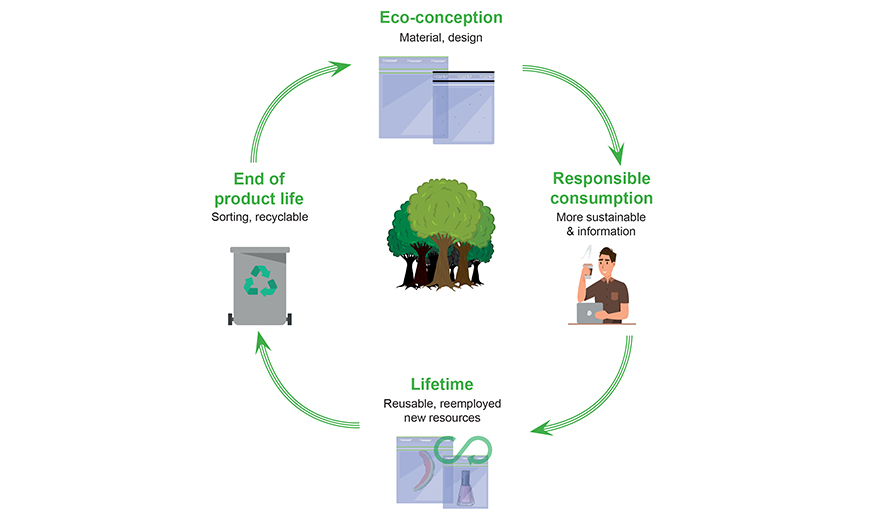
The AGEC law (“Anti-waste for a circular economy” and “Climate and Resilience”) of February 10, 2020, takes action against waste to transform our linear economy into a more circular one. This means moving from a disposable culture to reasonable, thoughtful, responsible, and more sustainable consumption and production. The AGEC law concerns everyone and meets the expectations of the French people regarding ecology through actions in daily life.
Implemented in February 2020, numerous measures have been carried out:
The removal of certain single-use plastic products that pollute the environment
The removal of plastic products concerns many stakeholders: those placing products on the market (manufacturers, supermarkets, etc.), restaurateurs, and also final consumers. Everyday plastic products such as cups, plates, cotton swabs, and cutlery have been removed and replaced by reusable or eco-responsible products. Since January 1, 2023, restaurateurs must serve washable and reusable tableware for all meals consumed on-site. Packaging around bulk fruits and vegetables has been removed. These various removal actions prevent more than 200,000 tonnes of plastic packaging from being placed on the market each year.
Better information and identification of products placed on the market for consumers
Various actions are being taken to better inform consumers for improved sorting, consumption, and waste recovery. This information allows consumers to be informed about best practices.
The Triman logo was introduced to allow consumers to sort waste. This pictogram represents a silhouette indicating sorting solutions for waste and used products: sorting bin, household waste, store, collection point, or recycling center. Sorting information has evolved to give a second life to products and recycle them better. To achieve this, a generalization of sorting has been implemented; all packaging can be sorted directly into the yellow bin to be collected and recovered according to the materials. This new way of sorting allows for the creation of new recyclability channels if necessary, such as PP plastic by 2025.
Article 13 of the AGEC law, relating to consumer information on the environmental qualities and characteristics of waste-generating products, stipulates that:
Those placing products on the market with their packaging must, for each of their concerned products, make available a “product sheet of environmental qualities and characteristics,” easily accessible, for example, via a search engine, on a dedicated page or website. For household packaging, this “product sheet” must provide information on compostability, the incorporation of recycled material, the possibility of reuse, and the recyclability of the packaging.
For 2023, only companies with a turnover exceeding €50M and placing 25,000 units of the concerned product on the market are affected. These thresholds will gradually decrease in 2024 (€20M and 10,000 units produced) and in 2025 (€10M and 10,000 units produced).
Failure to comply with these obligations may be penalized by up to €15,000 for a legal entity and €3,000 for a natural person.
And where does Flexico stand in all this?
Generally speaking, since January 1, 2022, Article L541-9-1 of the Environmental Code prohibits the use of the terms “biodegradable” and “environmentally friendly” or any other equivalent mention on packaging that is clearly confusing and/or too global for the consumer.
Depending on the range, our pouches incorporate post-consumer recycled or regenerated material (for example, 30% in Minigrip® PCR).
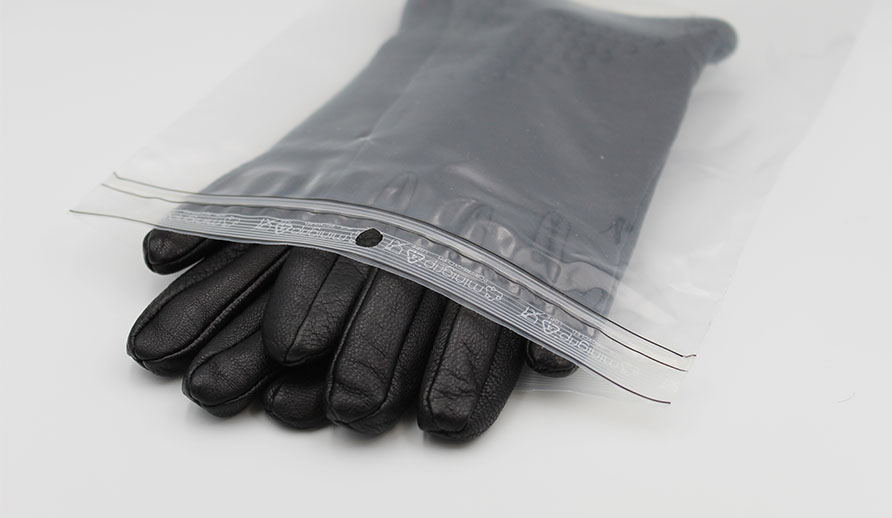
Flexico pouches are reusable (they are not supermarket checkout bags with a thickness of less than 50 µm, known as single-use, which the law has banned since 2016). Our pouches are even more reusable when they are, for example, equipped with a zip that allows the pouch to be easily opened and closed for subsequent use (Minigrip® par excellence).
And the majority of our pouches are recyclable, as they are mono-material and meet the criteria of recyclability channels.
Numerous actions are implemented daily to fight against food waste and preserve our planet.